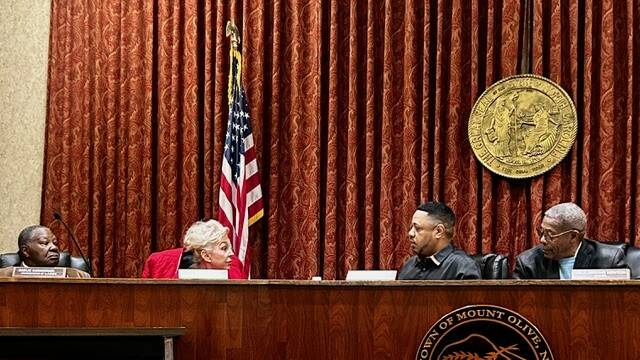
Left to right, commissioners Harlie Carmichael and Gena Messer-Knode listen as Mayor Pro Tem Delreese Simmons talks about the town’s water billing problems. At far right is Mayor Jerome Newton. (Georgia Dees|mountolivetribune.com)
Four days after the regular monthly meeting of the Mount Olive Board of Commissioners, where three new members were sworn in and a new Mayor Pro Tem was elected, Mayor Jerome Newton called a special board meeting, its stated purpose two-fold:
Consider approval of a reduction in the current 8 percent increase in water bill rates; and
Consider approval of a reduction in the current 7.5 percent property tax rates.
At the beginning of the meeting, Mayor Pro Tem Delreese Simmons asked if the board could add an item to the agenda that would allow the board to approve giving interim town manager Glenn Holland the authority to purchase commercial water meters for the town’s businesses.
Town Attorney Carroll Turner explained the item could be added to the agenda for discussion, but a vote could not be taken because the public had not been given notice that such a vote would take place. The board voted to add the discussion as an agenda item.
Next, the Mayor introduced the topic of water bill rates and asked for board discussion. Commissioner Gena Messer-Knode, elected in November to represent district 3, was the first to respond.
“At what point did we decide it was a good idea to start ‘averaging’ water bills?” she asked.
“I can’t answer that question because it was before my time,” the mayor responded. “I had the same question.” He went on to say there were people who own houses where nobody lives who were still getting water bills and added there were “other challenges” with bills, stating that’s why “it’s something we really ought to look at.”
Messer-Node continued: “At what point did my current water meter stop working … at what point did the water meter man stop coming to look at it?” She then asked if the person who read water meters for the town was still on the town payroll, but no one could answer the question.
When the commissioner continued questioning how individual water bills were being determined, including her own, Mayor Newton interrupted her and indicated her questions were off topic. “That’s not what we’re doing, we’re discussing this,” he said, pointing to the action item on the agenda: “ACTION MEMO 12-50 – Consider approval of a Reduction in the Current Eight Percent Increase of Water Bill Rates.”
Simmons joined in stating the current water bill averaging started before the current mayor came into office in 2023. “Everybody in this city knows that those meters have been set up on Wi-Fi for a long time,” he said.
“I think it’s a fair question,” she responded. “I think the people in the town of Mount Olive need to know their bills are basically being guessed.”
The lack of properly functioning water meters has been a town concern for months. Holland reported to the board in October he was expecting the new meters to be delivered and installed that month, but the board learned at the November meeting the meters still had not been received.
Most recent board discussions of the town’s water woes have centered around residential customer billing; however, Simmons stated at the October meeting and again at this month’s special meeting the town loses “hundreds of thousands of dollars each month” because some businesses in town don’t have water meters or have meters that don’t work properly. That means significant lost revenue for the town, he said.
The lack of a uniform billing process for commercial customers and the revenue loss is what prompted Simmons to bring his request for new commercial meters before the board. If the town couldn’t afford to purchase all the meters at once, he suggested they buy a few at a time and use the resulting revenue to buy more until every business is covered.
Mayor Newton said he was “a little dumbfounded” by the information Simmons shared, adding, “We have to fix this.”
At that point, commissioner C.J. Weaver asked how many meters were needed and who would install them? Again, there was no one who could officially answer the question on behalf of the town, but Simmons said, based on a previous conversation he had with Holland, he thought the town staff could install the meters.
When Weaver asked how many businesses operated in the town, no one could answer.
Simmons also said the town hadn’t cut off anybody’s water service in a year, which has cost the town revenue loss. “How can you turn anybody’s water off if you don’t know if their bill is correct?” he asked.
Messer-Knode asked how the commercial billing process was set up and how it got to the point Simmons was describing.
“I’m not throwing Glenn under the bus, but it was Glenn,” Simmons said. “He thought it would help, but it hurt.”
After further discussion, Messer-Knode said she believed it was time for the town to hire a permanent manager.
“I just think Glenn has done a wonderful job … but I think, given what we’ve learned over the last 30 days, it’s imperative that we find the best town manager that we can possibly find,” she said.
Holland, the town’s utilities superintendent, was appointed interim town manager in January 2025 after the previous board fired then manager Jammie Royall.
Medical reasons prevented Holland from attending this month’s special meeting.
In addition to water concerns, the board briefly discussed the town’s property tax rate, which by law cannot be adjusted until mid-2026. Turner reminded the board that if it wants to cut taxes it needs to work with town staff to find programs to cut back or eliminate.
“If you’re going to lower the tax rate, then you’ve got to reduce some expenses,” he said.
Taxes will be part of the board’s upcoming budget meetings, dates for which have not been set.
The next board of commissioners meeting is scheduled for Jan. 5, 2026, at 6 p.m. in the board meeting room, 114 E. James St.