
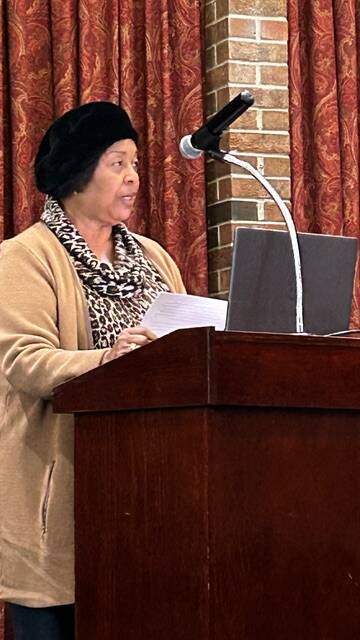


For the sake of the town, get the training you need so you can learn how to lead.
That’s the succinct version of the advice offered to the Mount Olive Board of Commissioners by the first public speaker at the group’s Nov. 10 meeting.
“We have elected new people who may not have experience in a town board capacity,” said Mount Olive resident Jerilyn Lee during the public comment segment of the meeting. “We are also retaining some members who may not have had the necessary training.”
The state requires all municipal board members to attend ethics training through the University of North Carolina School of Government, she said, noting the school’s classes on leadership, fiscal responsibility, budgeting and intergovernmental relations are important also.
“Mount Olive is at a pivotal point of either moving forward or regressing even further backwards,” said Lee, a former human resources director for Wayne County. “We need commissioners and administrators who can respond to issues with intelligence, forethought and insight, as well as knowing what state protocols to follow.
“It is time for our town to exhibit … professionalism,” she said. “No one should sit on this platform if they are unwilling or unable to fulfill this training. If you cannot read and understand a municipal budget, how can you properly manage our money? If you do not understand the taxation process, how can you effectively raise or lower taxes? If you do not know the requirements for proper municipal record keeping, how can you be accountable to the citizens of Mount Olive now, and future boards who may need to refer to past records?
“We currently have millions of dollars squandered and unaccounted for,” Lee added. “This must never happen again.”
(According to town clerk Sherry Davis, all current board members have attended the ethics training Lee suggested, and some have attended additional training sessions, as well. Interim town manager Glenn Holland and newly elected board members will attend early in 2026.)
Later in the meeting, during a public hearing about the Townwide Stormwater Master Plan, Lee’s advice regarding further training seemed on point.
After representatives from engineering firm McGill Associates reviewed the plan for public input, some board members made comments and asked questions that indicated they didn’t fully understand the purpose of the study, how it was funded, its parameters, what they were supposed to do with the information or when.
Mayor Jerome Newton, who oversees the agenda and runs the meeting, paused several times to ask for clarification about the study and its funding. Holland was absent due to sickness.
In a telephone interview later, Davis said she received the proposed plan from the contractor Nov. 6 and sent it the same day to every board member and the mayor so they would have time to review it prior to both the public hearing and the vote on whether to approve the plan. The document is almost 200 pages.
The public hearing opened with David Honeycutt and Cameron Long of McGill Associates presenting a 10-minute overview of the study, its findings and their recommendations.
“The point of this is the entire system is undersized … so there’s no localized solution that you can do,” said Long. “What you can do is a combination of storage upstream, and increase the capacity downstream, and kind of do a mixed project.
“You’re going to really have to upgrade your system,” he added. “You’re going to have to work with the railroad. It’s going to be a long process to get this done, and it’s going to be an expensive process to get this done. But this study does give you a road map and lets you know where you stand and what you need to do to get that level of service for your community, to allow you to start planning.
“Throughout this report you’re going to see the recommendation we have is going to be Alternative B,” Long explained further. “It’s focused on storage upstream, and increased capacity downstream.”
He noted the study included alternative solutions for the town to consider. “We’re not saying you have to take our recommendation. This report is going to frame up your system for you and help you make decisions, so when we ask you to adopt it, it doesn’t mean you’re going to do any of these projects, it doesn’t mean you’ve selected how you’re going to do them. It just means that you know you have these problems and you have these solutions.”
After the engineers’ presentation, district 2 commissioner Delreese Simmons, who acknowledged he had read “thirty something” pages of the document, asked Long to point out specific streets on the study’s map, specifically Morning Drive, Maple Street and Church Street, stating those areas are known to experience significant flooding.
“Why hasn’t anything happened over there, like no pipes, no anything?” he asked.
Honeycutt explained the company’s role was to collect and compile information on the town’s existing stormwater infrastructure and make recommendations on how to resolve the problem, not to do the actual work. He also pointed out that the area in question had been included in a previous study for the town by a different engineering firm, so when the current study was initiated, town officials selected new sites to analyze.
Honeycutt noted the initial inventory included “over 100 years’ worth of pipes in the ground that had no real contiguous mapping, no solid way to see what that overall situation looked like.” It meant identifying the condition of each piece of the town’s stormwater system.
Overall, the project took about two years to complete.
Commissioner Simmons then questioned the amount of funding and how it was used.
“You keep getting these grants, but there ain’t nothing happening down on the south side of town,” he said. “People are still under water, so where’s the grant money? Where is the work?”
Simmons then asked the engineers what the cost of the study was.
In fact, the grant under discussion is a $220,000 grant awarded to the town in 2022 as part of the American Recovery Plan Act following the Covid-19 pandemic. Its purpose is to create a framework of Mount Olive’s current stormwater infrastructure and what can be done to improve it.
The town of Mount Olive remains on a sewer moratorium that was placed by the state in 2015 due to its limited sewer capacity. The moratorium prohibits the town from taking on any new commercial or residential development, meaning the town’s growth has been stagnant for the past 10 years. The moratorium has been a major source of contention for residents who want town leaders to take action to fix the ongoing problem.
Removal of the moratorium is a primary goal of several grant-funded studies in recent years pertaining to the town’s stormwater and wastewater infrastructures.
The mayor asked Long to confirm who made the decision about which areas of town would be the focus of the study being considered, and Long confirmed the engineers took their direction from town administrators, one of whom was former town manager Jammie Royall who was dismissed by the board in March and is now deceased.
Long also explained the area Simmons was questioning had been included in a previous study by a different engineering firm, and that study could be referenced in the current study if the board chose to do so.
The mayor asked McGill Associates again to clarify its role was to provide research and information only, not to do the actual physical upgrading of the system. Long responded that was correct, and went further by outlining the firm’s responsibilities under the current study’s guidelines:
• Asset inventory collection
• Flood study
• Alternatives analysis
• Recommendation and alternatives
“It is just information for you to digest and come together as a community on how best to spend your money,” he said.
At-large commissioner Danny Keel said he and other citizens had concerns it wasn’t truly a “townwide” study. He also referred to “the Maple Street project,” another area that was covered by a previous study.
“There’s a lot of this stuff that’s out there that’s supposed to have been done or not been done or grant money or whatever, and it’s sort of confusing because, we as a board, we can’t keep up with all this stuff,” Keel said. “That’s the reason we rely a lot on town staff to help us with this stuff.”
While acknowledging the town’s infrastructure had been the subject of multiple studies, Honeycutt reminded the board the project to which Keel referred was managed by a different engineering firm.
Keel then asked about the deadline for the ARPA-funded grant to be submitted.
The goal is to submit the grant in February 2026, and the funds are mandated to be expended by the end of 2026, according to Honeycutt.
If the board votes to approve the study, the next step will be to submit it to the state’s Division of Water Infrastructure for approval. With that approval, the town can pursue additional grant funding to cover the cost of the actual infrastructure improvements.
At the end of discussion and after the public hearing, the board voted unanimously to table the vote on the Townwide Stormwater Master Plan until January so newly elected board members, all three of whom were in attendance, can have input. Simmons made the motion to table and Keel seconded the motion.
Leave a Reply